Cold, Flu, or Sinus Infection? When to See an ENT in Tampa Bay | Vitale ENT
Oct 19, 2026
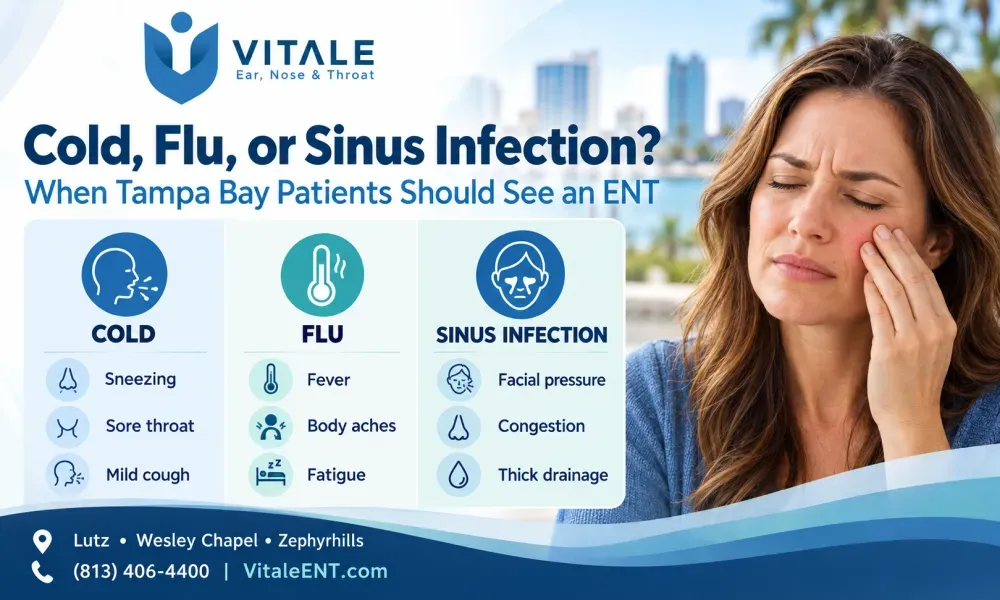
Fall marks the beginning of respiratory virus season, and many patients in Tampa Bay, Lutz, Wesley Chapel, Zephyrhills, Pasco County, and Hillsborough County start dealing with congestion, drainage, cough, headaches, fatigue, and facial pressure.
The challenge is that a common cold, influenza, allergies, and sinusitis can produce overlapping symptoms.
As of late September 2026, CDC reports that seasonal influenza activity remains low nationally, while rhinovirus/enterovirus activity is increasing. CDC considers October through May the fall and winter respiratory disease season, so respiratory infections are expected to become increasingly relevant as we move through the fall. CDC
Understanding the pattern of your symptoms can help you decide whether you need simple home care, a primary-care evaluation, or an ENT assessment.
The common cold is usually caused by a virus. Symptoms often develop gradually and may include:
Most uncomplicated viral upper respiratory infections improve with time.
The American Academy of Otolaryngology–Head and Neck Surgery notes that acute viral sinusitis is most likely when symptoms have been present for fewer than 10 days and are not getting worse. ENT Health
That 10-day timeline is useful because many patients assume colored mucus automatically means they need antibiotics. It does not.
Mucus can become yellow or green during a viral infection as the immune system responds. The duration and pattern of symptoms are often more helpful than mucus color alone.
Influenza often comes on more abruptly than a common cold.
According to the CDC, flu is more likely than a cold to cause:
Colds are more likely to cause sneezing and a stuffy nose, while flu more commonly causes systemic symptoms such as fever, aches, chills, and pronounced fatigue. CDC
The 2026–2027 flu season is just beginning. CDC's September 2026 outlook says influenza activity remains low nationally and there is currently no evidence that this season is more likely to be unusually severe, although severity cannot be predicted precisely before the season develops. CDC
If you develop significant fever, body aches, or flu-like symptoms, your primary-care clinician or urgent-care provider may be the best first stop.
This is where the timing becomes particularly important.
Sinusitis occurs when the lining of the nose and sinuses becomes inflamed. Swelling can block the small natural drainage openings of the sinuses, allowing mucus to become trapped.
Symptoms may include:
Most acute sinusitis begins with a virus.
In fact, ENT Health reports that approximately 98% of acute sinusitis cases are viral rather than bacterial. Antibiotics therefore do not help most early sinus infections. ENT Health
If symptoms continue or repeatedly return, learn more about sinusitis evaluation and treatment at Vitale ENT.
One of the most helpful ways to distinguish viral from possible bacterial sinusitis is the symptom timeline.
Symptoms have been present for less than 10 days and are gradually improving.
Symptoms do not improve at all after 10 days, or symptoms initially improve and then significantly worsen again.
Doctors sometimes call that second pattern “double worsening” or “double sickening.”
These criteria are part of current ENT guidance for diagnosing acute bacterial rhinosinusitis. ENT Health
This distinction matters because antibiotics should not routinely be used for viral respiratory infections.
Absolutely.
Florida's long allergy season means congestion occurring during cold and flu season may not necessarily be infectious.
Allergies are more likely to cause:
Allergies usually do not cause the body aches and fever associated with influenza.
Patients experiencing recurring congestion, sneezing, or seasonal symptoms may benefit from allergy testing at Vitale ENT rather than repeatedly treating presumed infections.
For uncomplicated viral symptoms, supportive treatment is often appropriate.
Depending on your health history, options may include:
ENT Health identifies saline irrigation and nasal steroid sprays among the commonly used treatments for acute viral sinusitis. ENT Health
Patients with heart disease, high blood pressure, glaucoma, prostate problems, pregnancy, or other medical conditions should ask a healthcare professional before using certain oral or topical decongestants.
A short viral illness generally does not require an ENT consultation.
However, an ENT evaluation may become valuable when the pattern suggests something more than an ordinary cold.
Consider evaluation if you have:
Chronic sinusitis is different from an acute infection. It is generally defined by symptoms lasting more than 12 weeks and often involves persistent inflammation rather than one prolonged bacterial infection. ENT Health
For ongoing obstruction, you can also review nasal congestion treatment options at Vitale ENT.
Repeated episodes deserve a closer look.
Recurrent acute rhinosinusitis generally refers to patients who experience multiple distinct sinus infections but return to their normal baseline between episodes. ENT Health defines recurrent acute rhinosinusitis as four or more acute sinus infections in one year. ENT Health
Potential contributors include:
An ENT examination may include nasal endoscopy or, in selected cases, sinus CT imaging.
The objective is to determine why the infections keep returning, rather than simply prescribing another medication each time.
Most patients with an ordinary cold or acute viral sinusitis do not need surgery.
But patients with persistent chronic sinusitis who have not improved sufficiently with appropriate medical treatment may have additional options.
For selected patients, balloon sinuplasty at Vitale ENT can enlarge blocked natural sinus openings and improve ventilation and drainage. Balloon dilation is not appropriate for every patient or every type of sinus disease, so candidacy requires an appropriate ENT evaluation. ENT Health
Other patients may benefit from different medical treatments or endoscopic sinus procedures depending on their anatomy and diagnosis.
Some symptoms should not wait for a routine ENT appointment.
Seek urgent medical attention for symptoms such as:
CDC also advises prompt medical attention for serious warning signs associated with influenza complications, including trouble breathing and chest pain. CDC
Cold and flu symptoms generally resolve with time, but persistent or recurrent sinus symptoms deserve a closer look.
If you have spent weeks dealing with congestion, pressure, drainage, decreased smell, or repeated “sinus infections,” the underlying problem may involve chronic inflammation, allergies, or structural blockage rather than another simple cold.
Vitale ENT evaluates patients with nasal and sinus symptoms throughout Lutz, Wesley Chapel, Zephyrhills, Tampa Bay, Pasco County, and Hillsborough County.
Rather than starting another round of temporary treatments, consider identifying the reason your symptoms are lingering.
Schedule a sinus evaluation with Vitale ENT.
Vitale ENT — Lutz • Wesley Chapel • Zephyrhills
Serving patients throughout Tampa Bay, Pasco County, and Hillsborough County.
Request an appointment: (813) 406-4400
Schedule online: Book an appointment with Vitale ENT
Website: VitaleENT.com